
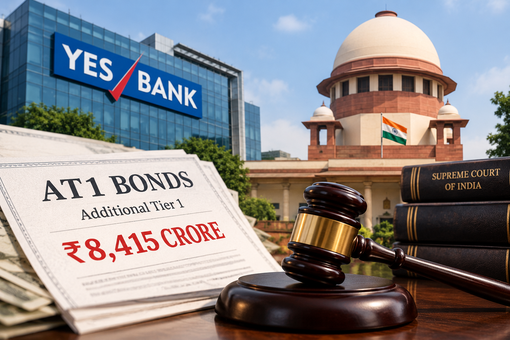
Supreme Court Yes Bank AT-1 Bond Judgment 2026: Key Legal Findings and Implications for Investors
The Supreme Court of India plays an important role in interpreting financial regulations, protecting legal rights, and ensuring that banks and regulatory authorities act within the framework of the law. On 15 October 2026, the Court delivered an important decision in the matter of Yes Bank Limited v. Axis Trustee Services Limited, concerning the write-off of Additional Tier-1 (AT-1) bonds issued by Yes Bank in 2020.
The dispute arose after Yes Bank’s AT-1 bonds, worth approximately ₹8,415 crore, were written off during the bank’s restructuring in March 2020. Bondholders challenged the decision, arguing that the write-off was not authorised under the applicable reconstruction scheme. The Bombay High Court set aside the write-off in January 2023, and the matter subsequently reached the Supreme Court.
The Supreme Court upheld the decision setting aside the write-off, making the case significant for financial institutions, investors, banking regulators, and legal professionals dealing with banking and securities disputes.
This judgment highlights the importance of statutory authority, regulatory compliance, and the terms of an approved restructuring scheme when financial institutions take decisions that affect investors’ interests.
What Are AT-1 Bonds?
Additional Tier-1 bonds, commonly known as AT-1 bonds, are financial instruments issued by banks to strengthen their regulatory capital. They are designed to help banks absorb losses and maintain financial stability during periods of financial stress.
Unlike conventional bonds, AT-1 instruments carry specific risks. They may have no fixed maturity date, and their terms can permit conversion into equity or a write-off under specified circumstances. Consequently, investors may face the risk of losing some or all of their investment.
These instruments are generally considered complex and are more suitable for investors who understand their contractual terms and associated risks.
Banks use AT-1 instruments as part of their capital structure, while regulatory frameworks establish conditions governing their issuance and treatment. The rights of investors depend on the applicable regulations, the terms of the instruments, and the legal documents governing any restructuring.
The Yes Bank dispute demonstrates why the authority to write off such instruments must be examined carefully rather than assumed merely because a bank is undergoing financial difficulties.
Background of the Yes Bank AT-1 Bond Dispute
In 2020, Yes Bank faced serious financial difficulties and underwent a restructuring process. As part of the events surrounding that restructuring, the bank’s AT-1 bonds were written off.
The write-off affected bondholders who had invested in these financial instruments. They questioned whether the bank’s administrator possessed the legal authority to eliminate the value of the bonds after the reconstruction scheme had been finalised.
The dispute eventually reached the Bombay High Court, which set aside the write-off in January 2023. The decision was challenged by Yes Bank and other parties, including the Reserve Bank of India and the Union government.
The central legal issue was whether the write-off could legally be carried out under the applicable restructuring framework and whether the administrator had the necessary authority to take that step.
The dispute was therefore not simply about the financial losses suffered by investors. It concerned the limits of legal authority and the interpretation of the approved reconstruction scheme.
On 15 October 2026, the Supreme Court upheld the Bombay High Court’s decision, providing significant clarification on the legal treatment of the disputed AT-1 bonds.
Key Findings of the Supreme Court
1. Actions Must Remain Within Legal Authority
An important aspect of the dispute concerned whether the bank’s administrator had the authority to write off the bonds after the reconstruction scheme was finalised.
The Supreme Court’s decision supported the conclusion that the disputed write-off was impermissible under the applicable scheme. The case reinforces the principle that financial institutions and their administrators must act within the authority granted by the governing legal framework.
Financial distress does not automatically give an institution unrestricted powers to alter investors’ rights. Any action affecting financial instruments must be supported by the relevant law, contractual provisions, and applicable regulatory arrangements.
For banks and other regulated entities, this makes it essential to examine the scope of their powers before implementing major restructuring decisions.
2. The Reconstruction Scheme Was Central to the Dispute
A major issue was whether the reconstruction scheme permitted the write-off of AT-1 bonds.
The Supreme Court’s decision upheld the position that the disputed write-off could not be sustained under the scheme as finalised. The judgment demonstrates the importance of carefully examining the language and scope of approved restructuring arrangements.
A financial institution cannot necessarily introduce or exercise a power merely because that power might appear commercially desirable during a crisis. The relevant authority must exist under the applicable legal framework.
This principle is important in restructuring matters involving banks, creditors, investors, and other stakeholders whose rights may be affected by decisions taken during financial emergencies.
3. Investor Protection and Regulatory Compliance
The dispute also raised concerns about the sale of complex AT-1 instruments to individual investors.
Such financial products carry significant risks, and investors must receive appropriate information about the conditions under which their investment could lose value. The case highlights the importance of following applicable regulatory restrictions and maintaining appropriate standards when marketing complex financial instruments.
However, investor protection does not mean that every investment loss is unlawful. The legal position depends on the facts, the applicable regulations, the instrument’s terms, and whether the relevant institution acted within its authority.
The judgment is therefore particularly relevant to disputes involving alleged mis-selling, disclosure obligations, and the exercise of powers over financial investments.
4. Regulatory Decisions Must Follow the Applicable Framework
The case also illustrates the relationship between banking regulation, government-approved reconstruction schemes, and the rights of investors.
Financial regulators and institutions operate within a statutory framework. Their decisions must be consistent with the powers and procedures established by the relevant law.
Where a dispute arises, courts may be required to examine whether an action was legally authorised and whether the governing documents permitted the decision taken.
This does not mean that courts replace regulators in every banking matter. Rather, judicial review can help determine whether a disputed action complies with the law.
Why Is This Judgment Important for Investors?
The Supreme Court’s decision is relevant to investors because it demonstrates that the treatment of financial instruments during a banking crisis may be subject to legal scrutiny.
Investors who purchase complex financial products should understand the conditions governing their investments, including provisions relating to loss absorption, conversion, restructuring, and possible write-offs.
The case also highlights the importance of preserving investment documents, transaction records, product disclosures, and communications with financial intermediaries.
If an investor believes that a financial instrument was sold in violation of applicable regulations or that an institution acted without legal authority, the investor may need to examine the available legal remedies.
Nevertheless, the judgment should not be interpreted as a guarantee that every investor will automatically receive immediate repayment. The practical consequences depend on the final operative directions, implementation of the judgment, the status of individual holdings, and any further legal or procedural developments.
Investors should review official disclosures and seek qualified legal or financial advice before taking action.
Implications for Banks and Financial Institutions
The judgment has implications for banks and other financial institutions that issue, distribute, or administer complex investment products.
First, institutions should ensure that their actions are supported by clear legal authority. Internal decisions taken during a restructuring process must remain consistent with the applicable scheme and regulatory framework.
Second, banks should maintain transparent documentation of major decisions affecting investors. Clear records can help demonstrate compliance and reduce uncertainty in subsequent disputes.
Third, institutions should pay attention to the suitability and disclosure requirements applicable to the financial products they distribute. Investors must be able to understand the material risks associated with complex instruments, subject to the relevant legal requirements.
Finally, restructuring arrangements should be reviewed carefully before implementation. Where the governing scheme does not clearly authorise a proposed action, institutions should obtain appropriate legal and regulatory clarification rather than assume that the action is permitted.
These steps can help reduce litigation risks and support greater confidence in the financial system.
Role of the Reserve Bank of India and the Regulatory Framework
The Reserve Bank of India has an important role in maintaining banking stability and establishing regulatory requirements for banks.
AT-1 instruments operate within a framework intended to strengthen banks’ capital positions and address financial stress. Their treatment may involve regulatory rules, contractual conditions, and the terms of a restructuring scheme.
The Yes Bank dispute demonstrates that these elements must be considered together. A regulatory framework may permit certain loss-absorption mechanisms, but a particular action must still comply with the applicable rules and the legal documents governing the institution’s restructuring.
The case should not be read as removing the RBI’s regulatory powers. Instead, it highlights the importance of identifying the precise legal authority for a specific action and determining whether the relevant requirements have been satisfied.
For financial institutions, regulators, and investors, clarity in these matters is essential to maintaining trust and ensuring that decisions are legally sustainable.
What Should Investors Do After the Judgment?
Investors affected by the AT-1 bond dispute should avoid relying solely on news headlines or general interpretations of the judgment.
They should consider the following steps:
- Review investment records: Keep copies of bond certificates, account statements, transaction confirmations, and other relevant documents.
- Check official disclosures: Review communications issued by the bank, relevant stock exchanges, and other appropriate authorities.
- Understand the judgment: Examine the operative directions and any subsequent implementation updates before assuming that repayment or restoration has occurred.
- Review potential legal remedies: Where a dispute concerns mis-selling, contractual rights, or regulatory compliance, seek advice from a qualified professional.
- Avoid premature conclusions: The outcome of a broader legal dispute does not necessarily determine every individual claim without considering the relevant facts and applicable procedures.
These measures can help investors understand their position and make informed decisions.
Broader Lessons for Banking and Commercial Disputes
The Yes Bank AT-1 bond judgment has wider relevance beyond the immediate dispute.
It highlights the need for legal certainty when financial institutions restructure their liabilities. Investors, lenders, banks, and regulators all depend on clear rules governing the rights and obligations of the parties involved.
The case also demonstrates that financial decisions made during periods of crisis can remain subject to judicial examination. Commercial urgency cannot, by itself, replace the need for lawful authority.
For businesses, the judgment is a reminder to examine contractual rights and statutory requirements before implementing decisions that could affect creditors or investors. For legal professionals, it provides a useful example of how financial regulation, administrative authority, and investor rights may intersect.
The precise application of the judgment will depend on its reasoning, operative directions, and the legal framework governing each relevant transaction.
Conclusion
The Supreme Court’s decision in Yes Bank Limited v. Axis Trustee Services Limited, delivered on 15 October 2026, is an important development in Indian banking and financial law. By upholding the decision setting aside the 2020 write-off of Yes Bank’s AT-1 bonds, the Court reinforced the importance of acting within the authority provided by the applicable reconstruction scheme and legal framework.
The judgment is relevant to investors, banks, financial institutions, regulators, and legal professionals dealing with complex financial instruments and restructuring disputes.
Its broader lesson is that financial stability and investor protection must operate within the boundaries of the law. Institutions should carefully examine their legal powers, maintain appropriate documentation, and comply with applicable regulatory requirements before taking decisions that affect investors’ rights.
Investors, in turn, should understand the risks associated with complex financial products and rely on official disclosures and qualified advice when evaluating their legal position.
Frequently Asked Questions (FAQs)
1. What was the Yes Bank AT-1 bond case about?
The case concerned the 2020 write-off of Yes Bank’s AT-1 bonds and whether that action was legally permissible under the applicable reconstruction scheme.
2. What did the Supreme Court decide in October 2026?
On 15 October 2026, the Supreme Court upheld the Bombay High Court’s decision setting aside the disputed AT-1 bond write-off.
3. What are AT-1 bonds?
AT-1 bonds are capital instruments issued by banks that carry specific risks and may contain provisions for loss absorption, conversion, or write-off under applicable conditions.
4. Does the judgment guarantee immediate repayment to every investor?
Not necessarily. The practical consequences depend on the operative directions, implementation of the judgment, individual holdings, and any relevant subsequent developments.
5. Why is the judgment important for banking law?
It highlights the importance of legal authority, compliance with reconstruction schemes, and the protection of rights associated with complex financial instruments.